Event
The old inhabitants of Pogradec and its surrounding villages tell that, deep at the very bottom of Lake Ohrid, facing the hills of Gështenjas, there lies a carved and forgotten stone throne. According to local lore, every morning Cadmus would sit there to gaze upon his tranquil and vanished kingdom. The throne, it is said, rests upon two rocks shaped like serpents, their bodies extending into the dark depths of the lake.
It is told that once a year, when the moon turns red and silence covers the lake’s surface, the throne rises for a brief moment above the waves. Whoever sees it will either receive a king’s fortune — or go mad from the sacred vision.
An old man used to recount that his grandfather had once seen the throne on a summer night, but had never spoken again. In a dream, Cadmus had appeared to him, commanding him to keep silent so that the secret of the lost kingdom remain undisclosed.
Some young men who once dared to seek the throne by boat claimed to have heard sounds of groaning and rattling of chains echoing from underneath the water, as if it were the voice of a bound king awaiting his release. An elderly woman warned them: “Do not disturb him! Cadmus is not dead. He guards Illyria!”
It is told that once a year, when the moon turns red and silence covers the lake’s surface, the throne rises for a brief moment above the waves. Whoever sees it will either receive a king’s fortune — or go mad from the sacred vision.
An old man used to recount that his grandfather had once seen the throne on a summer night, but had never spoken again. In a dream, Cadmus had appeared to him, commanding him to keep silent so that the secret of the lost kingdom remain undisclosed.
Some young men who once dared to seek the throne by boat claimed to have heard sounds of groaning and rattling of chains echoing from underneath the water, as if it were the voice of a bound king awaiting his release. An elderly woman warned them: “Do not disturb him! Cadmus is not dead. He guards Illyria!”
There is no audio content available. Add an audio URL in the admin panel.
There is no video content available. Add a video URL in the admin panel.
Historical period:
From the 5th century BCE onward
Historical overview of the period
The myth of Cadmus features amongst the oldest narratives of Greek mythology, mentioned by Euripides (The Bacchae, 1330–1341) and Apollodorus (Bibliotheca, III, 5, 4). Closely linked with the foundation of Thebes, it recounts how Cadmus, a Phoenician prince, set out to find his sister Europa, abducted by Zeus, and in doing so founded new civilizations.
According to ancient sources, after a reign marked by both greatness and tragedy, Cadmus and his wife Harmonia left Thebes and journeyed northwest, to the lands of the Illyrian tribe of the Enchelei — later known as the Desaretes — who inhabited the region around Lake Ohrid. Herein, myth and Illyrian history intertwine: Cadmus not only lived in Illyria but also fought neighboring tribes and founded a city. This is one of the rare cases where a Greek mythological figure becomes integrated into the local Illyrian mythic tradition.
The Cadmus myth is unique in classical literature because it is the only Greek myth that explicitly situates Illyria as its mythical setting. No other Greek hero is so clearly portrayed in ancient sources as traveling to, ruling over, and settling in Illyrian lands. Ancient authors did not treat Illyria as an undefined frontier land but rather described the territory of the Enchelei (corresponding to the Pogradec–Ohrid region) as the very place where Cadmus lived and reigned. This precise geographic localization makes the myth profoundly significant for Illyrian mythology, even though its origins remain Phoenician and Greek.
Through centuries of contact and cultural exchange well-attested by archaeology, the myth was adopted and reinterpreted by local Illyrian elites, who embraced Cadmus as their mythic ancestor.
Conditions that gave rise to the event
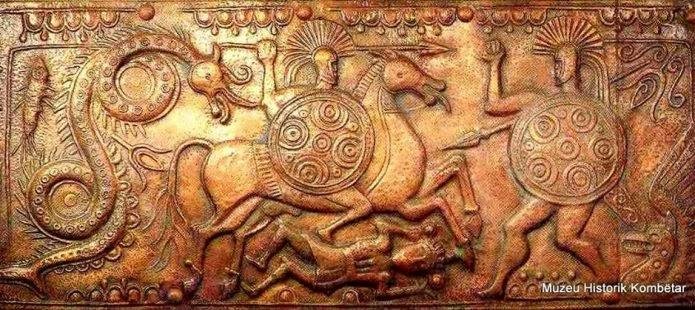
One of the most intriguing archaeological finds linked to the Cadmus myth is a bronze belt plaque (22 × 5 cm) discovered among the grave goods of the rock-cut tombs at Lower Selca. The scene depicts a standing warrior with his right arm raised, hurling a spear. To his right and left stand two soldiers mounted on horses. All three figures wear Illyrian-style helmets and carry Macedonian-type shields. A fallen warrior lies besides the horseman on the left, whereas a monstrous creature is depicted running towards the right-hand side horse, whereby a bird is shown taking flight. At the left edge appears a large serpent, with its scaly body coiled twice and its head raised and turned toward the horseman, as though offering him protection.
Message
The figure of Cadmus metamorphosed into a serpent embodies the positive forces of military protection and ancestral guardianship — values deeply resonant with Illyrian beliefs. Objects such as the Selca belt plaque visually echo this symbolism. Although the myth itself is not of local origin, it was naturally assimilated into Illyrian culture by virtue of harmonizing with their traditional symbols and worldview. Cadmus, as a “marginal” hero, became an intermediary figure — representing the passage from chaos to order, from wilderness to civilization. In this sense, he emerged as a cultural archetype, a trans-Balkan hero whose significance transcended linguistic and ethnic boundaries, bridging worlds through myth.
Meaning in Today’s Context
In today’s context, the myth of Cadmus conveys several particularly important messages, such as the model of coexistence and the coordination of cultures. Although it belongs to a culture that is not indigenous, this myth finds a place and meaning in a new land, reflecting the ability of communities to adopt and adapt according to local beliefs and symbols. The embrace of the cult of Cadmus and its integration into the local reality demonstrates an early need to create cultural continuity and rooted identity. Even today, this myth can serve as inspiration for recognizing and preserving cultural heritage, helping to build a strong and conscious identity.
Bibliography
- Oral traditions collected in Pogradec, Gështenjas, and Lin by researchers of the Institute of Folk Culture (1980s–1990s).
- Ceka, Neritan. Ilirët [The Illyrians]. Tiranë: Toena, 2012 — includes discussion on the localization of the Cadmus myth in Lake Ohrid.
- Domi, Mahir. Motivet mitike në folklorin shqiptar [Mythical motifs in Albanian folklore]. Tiranë: SHBLSH, 1987.
- Castiglioni, Maria-Paola. Cadmos-serpent en Illyrie: Itinéraire d’un héros civilisateur. Pisa University Press, 2010.
- Unpublished oral interviews from long-established families in Pogradec, referenced in academic studies on cultural memory.