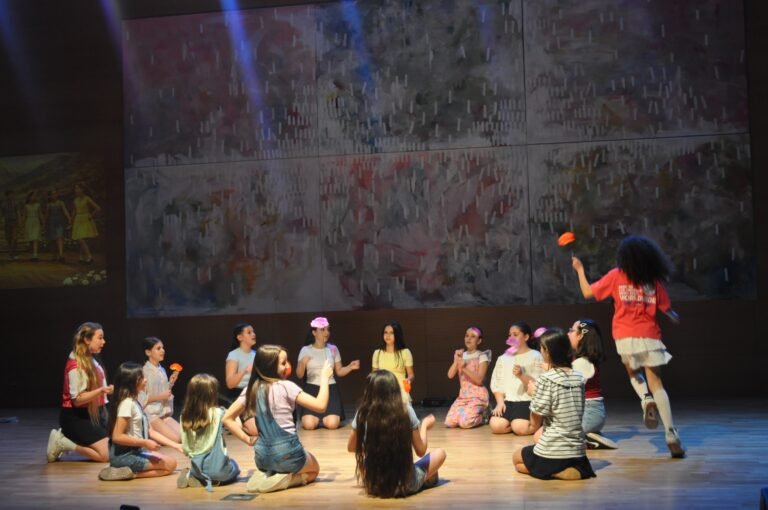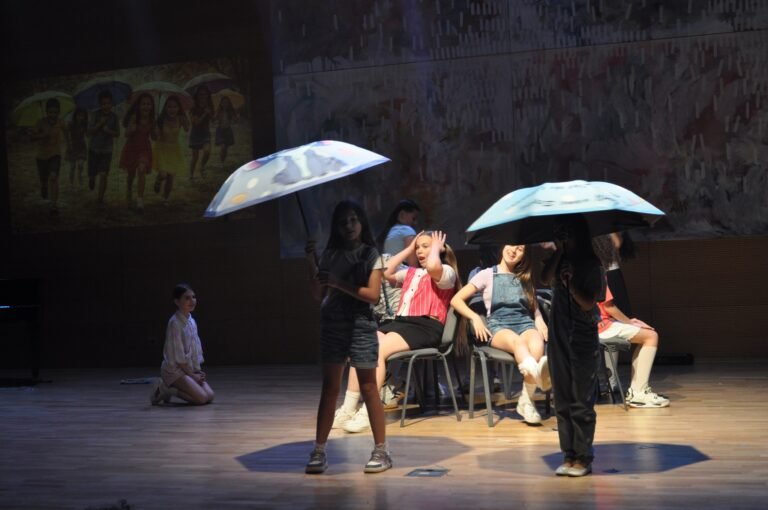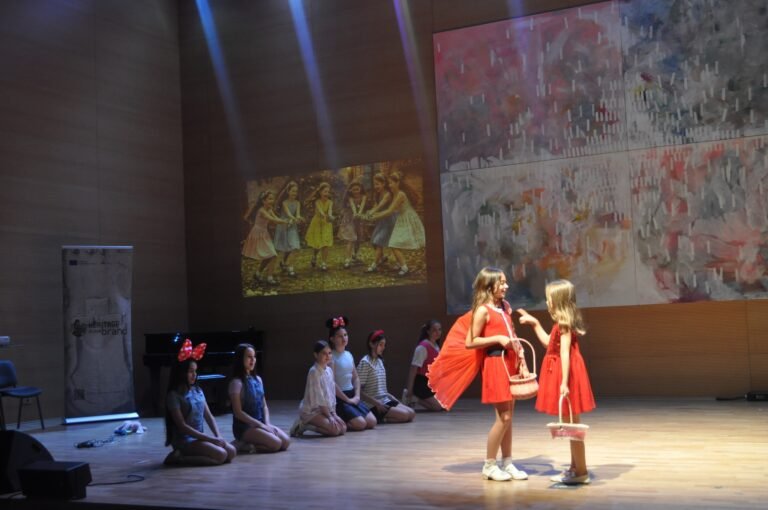
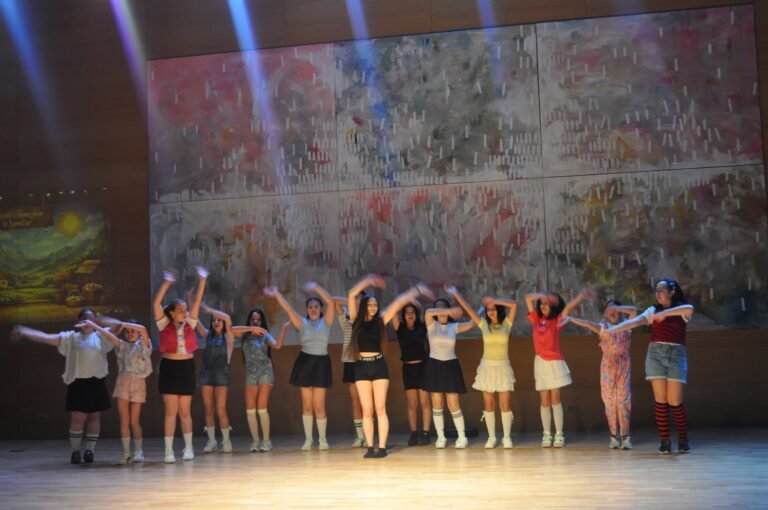
The musical featuring Albanian folk songs and traditional games opened the curtain on the fifteen artistic projects awarded through the “Heritage Is Our Brand” grants, funded by the European Union and implemented by DMO Albania and EU Policy Hub.
Composer Endrit Muçaj brought to young audiences — as well as to the nostalgic memories of parents — twelve songs accompanying twelve games once played by Albanian children.

The premiere performance took place on the afternoon of April 28 at the premises of Jordan Misja Artistic Lyceum in Tirana, in a hall filled with children and parents who enjoyed a true spectacle reviving the tradition of Albanian folk games.
With the participation of students from Pjetër Budi School and music teacher Elda Kuqja, the children delivered an emotional performance through games such as “Dembeli,” “Karamele Zana,” “Loja me Peta,” “Loja me Litar,” “Lule Dele,” “Shi Shi Babashi,” “Roza-Rozina,” “Hapa Dollapa,” “Kala Dibrançe,” and many others, reviving the spirit of tradition in a contemporary artistic form.
Composer Endrit Muçaj, one of the winners of the European Union-funded grant scheme, explained how he drew inspiration from Albanian folk games to create twelve unique musical compositions.
blo


We tried to create a children’s performance from several musical pieces composed by me and based on old games once played by children. We brought them back today in the form of a reminder within this musical. The starting point was the call for projects focused on intangible cultural heritage, and one of the things I chose were old children’s games. Initially, the impact came from the game ‘Kala Dibrançe’ and many other games that children today have almost forgotten, and we wanted to remind them of these traditions. To build such a performance and bring it back beautifully, we had to add other elements as well. We added music to the stage numbers, which I had to compose entirely from scratch, and in this way it became a complete show built like a musical performance, which is why we gave it the title of a musical,” he explained, while also highlighting the challenges during the creative process.
“One of the first difficulties was selecting the games because naturally not every game was suitable for the stage. We had to consider the possibilities for children to perform them, the stage capacities, and the duration, and we tried to show a little bit of everything. Beyond entertainment, we also reminded today’s parents of their childhood, while every parent enjoys seeing their children debut on stage in a beautiful performance. Today, all of them were true artists.”
Music teacher Elda Kuqja, who created the choreography for the twelve compositions, said that this musical is the first of its kind in Albania and will remain memorable for generations.
“A musical that will stay with future generations because it is the first time such a performance has been staged in Albania. It featured various folk games from the first to the twelfth act, intertwined with choreography created by me. It was exhausting but also a great pleasure. The children truly enjoyed themselves on stage. They played real games live on stage. Although I staged the whole situation from beginning to end, they performed with such freedom that they conveyed every game naturally to the audience, making everyone feel as though they were truly playing downstairs in the neighborhood or in front of their apartment buildings. ‘Kala Dibrançe,’ which was a very special game, brought tremendous emotion to the stage, especially for the boys who are very energetic and hard to organize, yet they enjoyed it together with the audience.”
For the director of “Heritage Is Our Brand,” Eva Kushova, beginning the grant events with children carries special meaning and importance, since the project’s main goal is to pass Albania’s intangible cultural heritage on to younger generations.
“We have a project supported by the European Union through which we want to strengthen national pride and pass on all the values of our spiritual and intangible heritage to future generations. Our aim is to support artists. What you saw today focused on the artist, but we realized the real focus was on the children, and that is exactly why we began with a performance for them. We want children to learn more about everything beautiful we have inherited and can pass on — games, childhood memories, traditions, costumes, rituals, and everything valuable connected to our identity. We want them to know who they are and where they come from, so wherever they go in the future, they will know their roots and cultural belonging. Today’s work was the artistic creation of Endrit Muçaj, and there could not have been a better way to begin than with children.”

This activity aims to bring younger generations closer to Albanian folk culture by introducing them to the games once played by children in courtyards, meadows, villages, and city streets. Through these games, children become more social, kinder, wiser, and more entertained.
From “Books of Light,” a documentary about Flija in Kukës, to an installation dedicated to the xhubleta in Malësia e Madhe, a mosaic inspired by Baliska wine in Durrës, an installation for the flutes of Gramsh, a moving stained-glass installation in Elbasan, a bas-relief in Krujë dedicated to the history of Gryka e Vajës, video projections such as “Gjama e Burrave” and “Gjin Aleksi Mosque,” the theatrical performance “Constantine the Great” and “Sunday Off,” graphic novels for children based on ten legends, and an ethno-jazz concert — all are unique artistic products inspired by the stories of the “Heritage Is Our Brand” project and will conclude on June 18, 2026.
After more than a year of work — including surveys with young people regarding their knowledge of intangible cultural heritage, the publication of forty stories compiled by renowned historians on the platform, and the financing of fifteen creative initiatives — “Heritage Is Our Brand” has now reached the stage of artistic productions.
More about the project: www.albaniaheritage.com