Event
It is the last summer of the 19th century. In the courtyard of the Vali’s palace in Ioannina, the ground trembled not from the collapsing of empire but from such steps that would change a life and even defy the very notion of justice of the time. Surrounded by soldiers, officials and fellow townspeople, among them relatives of the Vali himself, there walked a young man from Konispol, dark-haired and steady-eyed. His name was Osman Taka, an Albanian from the region of Çamëria, condemned to death. He walked with calm and measured steps, akin to a man not going to the gallows raised in the town’s middle but rather a wedding. His gaze wandered toward the distant mountains.
His story begins earlier, in the quiet villages of Çamëria. According to oral tradition, Osman’s unmarried sister had been assaulted by Ottoman soldiers. Bound by the code of honor of his place and time, Osman could not remain silent. He avenged her and killed those who had violated what was sacred. He was pursued, captured and brought before the empire’s justice. The sentence was severe: death by hanging. Yet Ottoman law preserved one ancient custom of lenience for the condemned could ask for a final wish.
Osman Taka, in a calm and resolute voice, said: “I wish to dance — my dance. Once more, before I die.”
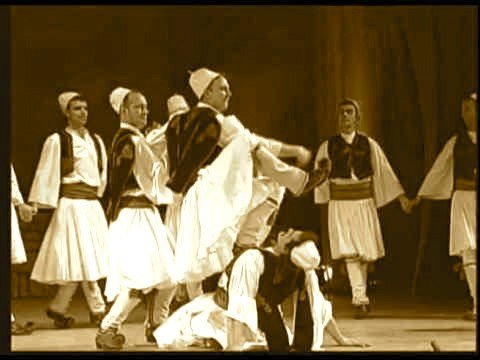
The Vali looked at him, at first in astonishment, then in curiosity. It was no ordinary request. It was granted. Drums and flutes were brought, while other dancers from Konispol who happened to be thereabouts were called in. When the first steps struck the ground, silence fell over the courtyard. Osman Taka began his dance with extraordinary grace. There was nothing ordinary about his movements for he did not dance like a man facing death, but like a spirit newly born. With every step, he rose above pain and fear. When he knelt in the middle of the circle and bent backward, his head touching the earth, his chest opened. Another dancer, following tradition, placed a foot gently upon his chest — a gesture symbolizing both the weight of oppression and the endurance of those who does not yield. All thought the dance had ended. But then, with the lightness of breath itself, Osman Taka rose ever slowly, leaning only on one hand. Like a flower blooming from the soil after the storm. Like a people rising from ruins. Like a man who, though crushed, is reborn through beauty.
The Vali was speechless. His family sat in awe. Then his wife spoke first: “A man who dances like this cannot be hanged.” The words spread like the wind. Even those who had lost kin by his hand felt that he was no murderer, but a soul who could heal through dance.
Finally, stern but fair, the Vali stood up and declared: “This man shall not die today. He shall live — to dance again, and so that we may remember not his blood, but the light he has given us.”
.” And so it was. Osman Taka returned to Konispol. He spoke little. But on nights when the full moon hovers over the sea of Butrint and the wind carries whispers from the mountains of Çamëria, the young men of the village still perform his dance. Its rhythm going beyond movement, weaving a story and a life redeemed by beauty. His house still stands… ruined, yet proud. No plaque, no monument… only memory… Every year, when the youth are brought into learning the Dance of Osman Taka, they learn the timeless truth that, at times, dance is stronger than death.
His story begins earlier, in the quiet villages of Çamëria. According to oral tradition, Osman’s unmarried sister had been assaulted by Ottoman soldiers. Bound by the code of honor of his place and time, Osman could not remain silent. He avenged her and killed those who had violated what was sacred. He was pursued, captured and brought before the empire’s justice. The sentence was severe: death by hanging. Yet Ottoman law preserved one ancient custom of lenience for the condemned could ask for a final wish.
Osman Taka, in a calm and resolute voice, said: “I wish to dance — my dance. Once more, before I die.”
The Vali looked at him, at first in astonishment, then in curiosity. It was no ordinary request. It was granted. Drums and flutes were brought, while other dancers from Konispol who happened to be thereabouts were called in. When the first steps struck the ground, silence fell over the courtyard. Osman Taka began his dance with extraordinary grace. There was nothing ordinary about his movements for he did not dance like a man facing death, but like a spirit newly born. With every step, he rose above pain and fear. When he knelt in the middle of the circle and bent backward, his head touching the earth, his chest opened. Another dancer, following tradition, placed a foot gently upon his chest — a gesture symbolizing both the weight of oppression and the endurance of those who does not yield. All thought the dance had ended. But then, with the lightness of breath itself, Osman Taka rose ever slowly, leaning only on one hand. Like a flower blooming from the soil after the storm. Like a people rising from ruins. Like a man who, though crushed, is reborn through beauty.
The Vali was speechless. His family sat in awe. Then his wife spoke first: “A man who dances like this cannot be hanged.” The words spread like the wind. Even those who had lost kin by his hand felt that he was no murderer, but a soul who could heal through dance.
Finally, stern but fair, the Vali stood up and declared: “This man shall not die today. He shall live — to dance again, and so that we may remember not his blood, but the light he has given us.”
.” And so it was. Osman Taka returned to Konispol. He spoke little. But on nights when the full moon hovers over the sea of Butrint and the wind carries whispers from the mountains of Çamëria, the young men of the village still perform his dance. Its rhythm going beyond movement, weaving a story and a life redeemed by beauty. His house still stands… ruined, yet proud. No plaque, no monument… only memory… Every year, when the youth are brought into learning the Dance of Osman Taka, they learn the timeless truth that, at times, dance is stronger than death.
There is no audio content available. Add an audio URL in the admin panel.
There is no video content available. Add a video URL in the admin panel.
Historical period:
Late 19th century (Rilindja Kombëtare – the National Renaissance).
Historical overview of the period
In the second half of the 19th century, while Albania remained under Ottoman rule, Albanians began to organize more consciously for national freedom and cultural identity. This was the era of the National Renaissance, a multifaceted movement that was not only political or educational, but also profoundly social and spiritual. It was a time of flourishing for the Albanian language, literature and cultural expression. This was a golden age for the diffusion of the Albanian language through written works, the demanding of national rights, the opening of schools in the Albanian language and the organization of national resistance against injustices of the Ottoman empire administration.
Folk culture — songs, dances, legends — provided not merely entertainment but powerful means of survival, national awareness and resistance. It was the voice of a people who, though politically oppressed, continued to affirm their dignity and identity through artistic and symbolic expression.
Conditions that gave rise to the event
According to oral tradition from Çamëria, Osman Taka was renowned for his courage, dignity and free spirit. The popular tale recounts that he was arrested and sentenced to death by Ottoman authorities after avenging a grave injustice against his family in an act considered at the time a moral duty for restoring honor. Before his execution, he invoked the right to a final wish and asked to dance his Çam dance. What followed was not simply a farewell ritual, but a manifestation of life and beauty in defiance of death. The dance — with its slow, solemn kneeling gestures and graceful rises — was perceived by the spectators as a wordless prayer, a plea for life through art and dignity. The powerful emotions deeply moved those present, including the Vali’s family, leading to the pardoning of Osman Taka. The dance he performed, now bearing his name, entered Albanian collective memory not merely as folklore, but as a testimony to the power of the human spirit and beauty to overcome violence and mortality.
Message
The Dance of Osman Taka is more than a jewel of Albanian folklore — it is a living testament to the spiritual resistance of the Albanians of Çamëria, who defended their family and national honor in the face of injustice. Born in the dark times when the Ottoman Empire sought to suppress all signs of dissent, this dance became a symbol of non-military triumph and of the victory of the soul. Osman Taka of Konispol achieved immortality not through the sword, but through art. Within the broader epic of Çam suffering, his dance acquires meanings beyond remembrance and becomes the embodiment of a people’s pride — graceful yet unbroken, untouched by oppression or later ethnic persecution. Today, the Dance of Osman Taka reminds new generations not only of their ancestors’ artistic heritage but also of the enduring drama of a people still seeking justice.
Meaning in Today’s Context
The dance of Osman Taka is not merely a treasure of Albanian folklore, but a living testament to the spiritual resistance of the Cham Albanians in preserving family and national dignity in the face of injustice. Born in dark circumstances, when the Ottoman Empire sought to suppress every sign of opposition, this dance became a symbol of a victory not through arms, but through spirit. Osman Taka, born in Konispol in the heart of Çamëria, became immortal not through weapons, but through art.
In the epic of Cham suffering, the dance of Osman Taka takes on a new meaning. It is no longer just a memory, but a representation of the very soul of a persecuted people — a graceful display of pride that could not be defeated even by Ottoman swords and later ethnic genocide. Today, performing the Osman Taka dance reminds younger generations not only of the heritage of their ancestors, but also of the enduring struggle of a people still seeking justice.
Bibliography
- Polacco, Fabrizio. “Osman Taka, a young warrior who saves himself from a death sentence...” (2018).
- Institute of Popular Culture, Çamëria Collection.