Event
In the early 1970s, three Albanian sculptors worked with uncommon devotion in a quiet studio in Tirana. They had been entrusted with an extraordinary task: to create a monument for the National Martyrs’ Cemetery — one that would not merely commemorate the fallen but would also embody the very conscience of the nation.
They did not seek to raise an ordinary statue. They sought a spiritual center of gravity — a body that would bear the memory of the past and inspire an entire people, a figure that would represent not only the past but also articulate a moral call to the future.
In the midst of their work, among modelling clay and immersed in concentration, they spoke softly to one another:
“She must stand as Albania has stood,” said one.
“She must not speak — but her gaze must burn,” added another.
“And she must be a mother,” concluded the third, “a mother who does not mourn her sons, but grants them eternity.”
Day after day, they modeled with persistence: an upright body, a raised and composed head, a face without defined individuality — yet with features that could belong to every Albanian woman throughout history.
But night brought another dimension. In the stillness of late hours, the clay seemed to breathe. A voice — born of stone and soil — whispered to the artists shaping it:
“I am Mother Albania.
You give me form, but I was born centuries ago.
I watch over the sons who have fallen for the Homeland and keep them always by my side.
I am a wounded memory, but also an inspiration waiting to speak to the generations to come.
Do not make me beautiful.
Make me worthy of the pain and pride I represent.
Let my stance be a silent command, and my image — more conscience than ornament.”
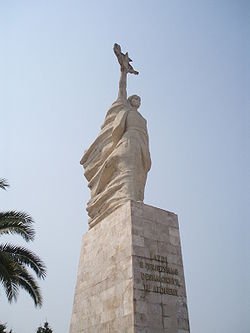
When the monument was completed and placed on the hill of the Martyrs’ Cemetery in 1971, many who saw it for the first time could find no words to utter. It sought neither applauses nor anthem singing. Standing 12 meters tall in bronze, it was not the likeness of a living woman but the embodiment of all Albanian women — those who had borne and buried sons in war, learned the Albanian language in secrecy, and kept alive the flame of identity through centuries.
“Mother Albania” stands upright, built on a strong vertical axis, austere and unadorned — conceived as a pillar of strength conveying authority and endurance. Her raised hand does not bless, nor does it embrace — it summons. It calls for devotion, responsibility and love for the homeland not as a gift, but an ancient trust.
Her gaze features no sorrow, no nostalgia. Her gaze seems emits a loud call, while she teaches in silence of words. She speaks to every generation that passes in front of her. She is a monument of conscience and remembrance, inviting reflection to understand not only who we once were, but who we must strive to be.
From that day onward, the monument became more than a site of homage to the fallen ones — it became a national space of reflection, where memory and challenge, reverence and responsibility meet. Mother Albania stands there still, day and night, watching over her martyrs and inspiring those who climb up the hill to see her up close. She does not speak aloud, yet anyone who pauses in front of her can hear the silent eternal question:
“Do you love this land enough? Do you deserve this mother?”
They did not seek to raise an ordinary statue. They sought a spiritual center of gravity — a body that would bear the memory of the past and inspire an entire people, a figure that would represent not only the past but also articulate a moral call to the future.
In the midst of their work, among modelling clay and immersed in concentration, they spoke softly to one another:
“She must stand as Albania has stood,” said one.
“She must not speak — but her gaze must burn,” added another.
“And she must be a mother,” concluded the third, “a mother who does not mourn her sons, but grants them eternity.”
Day after day, they modeled with persistence: an upright body, a raised and composed head, a face without defined individuality — yet with features that could belong to every Albanian woman throughout history.
But night brought another dimension. In the stillness of late hours, the clay seemed to breathe. A voice — born of stone and soil — whispered to the artists shaping it:
“I am Mother Albania.
You give me form, but I was born centuries ago.
I watch over the sons who have fallen for the Homeland and keep them always by my side.
I am a wounded memory, but also an inspiration waiting to speak to the generations to come.
Do not make me beautiful.
Make me worthy of the pain and pride I represent.
Let my stance be a silent command, and my image — more conscience than ornament.”
When the monument was completed and placed on the hill of the Martyrs’ Cemetery in 1971, many who saw it for the first time could find no words to utter. It sought neither applauses nor anthem singing. Standing 12 meters tall in bronze, it was not the likeness of a living woman but the embodiment of all Albanian women — those who had borne and buried sons in war, learned the Albanian language in secrecy, and kept alive the flame of identity through centuries.
“Mother Albania” stands upright, built on a strong vertical axis, austere and unadorned — conceived as a pillar of strength conveying authority and endurance. Her raised hand does not bless, nor does it embrace — it summons. It calls for devotion, responsibility and love for the homeland not as a gift, but an ancient trust.
Her gaze features no sorrow, no nostalgia. Her gaze seems emits a loud call, while she teaches in silence of words. She speaks to every generation that passes in front of her. She is a monument of conscience and remembrance, inviting reflection to understand not only who we once were, but who we must strive to be.
From that day onward, the monument became more than a site of homage to the fallen ones — it became a national space of reflection, where memory and challenge, reverence and responsibility meet. Mother Albania stands there still, day and night, watching over her martyrs and inspiring those who climb up the hill to see her up close. She does not speak aloud, yet anyone who pauses in front of her can hear the silent eternal question:
“Do you love this land enough? Do you deserve this mother?”
There is no audio content available. Add an audio URL in the admin panel.
There is no video content available. Add a video URL in the admin panel.
Historical period:
Artistically: 20th century. As a national sentiment: centuries-old.
Historical overview of the period
The concept of Mother Albania is not a literary or political invention. It is the embodiment of a deep collective sentiment that existed long before the ideological expressions of the National Renaissance (Rilindja Kombëtare). Even when lacking a state, Albanians perceived themselves as a community united by blood, language and custom — often imagined as a symbolic mother who protects, calls, nurtures and admonishes her children. Since antiquity and the Middle Ages, the Albanian language, customary law, ancestral traditions and epic songs of bravery preserved a consciousness that, though not yet national in the modern sense, anticipated it.
During the National Renaissance of the 19th century, this deep-seated feeling gained a proper name and articulate voice. In Naim Frashëri’s poetry and Abdyl Frashëri’s oaths, the notion became clear: Albanians were the children of a single mother — Mother Albania. She was not an abstract figure but a living synthesis of language, history and collective memory, nurturing the spirit of “Albanianhood.”
Thus, the Albanian national identity of the 19th century was not a borrowed construct or a romantic invention. It was the crystallization of an enduring sense of belonging, preserved in oral tradition, customary law, heroic ballads and shared rituals. The figure of Mother Albania was born in this context — as a spiritual surname of the homeland, symbolizing unity through kinship.
Conditions that gave rise to the event
The long centuries of foreign domination never subdued or assimilated the Albanian people. On the contrary, they deepened the sense of ethnic and cultural survival, transmitted from generation to generation by way of spiritual heritage. This feeling of belonging — though not yet formally national — lived on as ethnic and moral conscience, manifested in shared rituals, customary codes, the preservation of language and the remembrance of ancestors. It intensified during the 18th–19th centuries, when the Albanian language, historical mythology and the cult of Skanderbeg took a renewed form, standing for liberty and honor.
Through these processes of reinforcement of collective memory and spiritual unification, the figure of Mother Albania emerged spiritually and emotionally – shaped by the voices of women in laments that mourned not only the dead but also the wounded homeland, in wedding blessings recalling nostalgia for the birthplace, and in family epics where the homeland appeared as a mother who waits, prays or curses. She was wounded and humbled, yet always alive — a symbol of endurance and hope.
Unlike the analogous national figures of other nations, which often arose as allegories of statehood or republican ideals, Mother Albania was not a forging of of political doctrine. She rose from the people — as a popular spirit, a feeling carried through songs, prayers and acts of quiet resistance.
Her uniqueness lies in her ethical and spiritual roots — in her link to blood, language and soil, rather than transient political ideologies. She is less an allegory of the state than a moral conscience of the nation, one that preceded and outlived every regime.
Message
Mother Albania is not just an artistic figure or a monument of a bygone era. She is the embodiment of collective Albanian conscience, the inner voice that preserved national identity throughout the centuries, not with scepter or crown, but through the living memory and an unextinguished tongue. She is not only the mother of the fallen but also the guardian of the homeland in all its forms: land, language, honor and belonging. She stands not to mourn, but to command in silence — not to glorify a glorious past, but to demand continuity.
Mother Albania stands as a reminder to every generation – that being Albanian is not a matter of name or lineage, but rather of devotion to the land raising you, the language you speak and the dignity that sustains you. She stands tall representing those who do not surrender even when others depart or when times change — for she stands for roots, the heart and shared memory.
Meaning in Today’s Context
In an era where globalization treats national belonging as a label-free commodity, where emigration is emptying villages and towns, and where national identities dissolve into fluid definitions, "Mother Albania" stands as an unshakable symbol of Albanian roots. She does not belong only to the past but serves as a constant reminder not to forget who we are.
At a time when the Albanian language is challenged by foreign words, when history is relativized, and when the homeland is sometimes experienced more as a memory than as belonging, her figure emerges as a moral reminder: Albania is not merely a space on the map but a collective soul living in every Albanian word kept alive, in every song that names the land, in every mother who teaches her children the names of their ancestors.
She poses a silent, unavoidable question: “Are you preserving what gave you life?” For without identity, there is no freedom; without language, there is no heritage; and without history, there is no future. Mother Albania reminds us that we are not only what we have been, but what we choose to be.
Bibliography
- Zeqo, Moikom. Misteret e figures [The Mysteries of the Figure]. Tiranë: Onufri, 2001.
- Dushku, Fuat. Art dhe ideologji: monumentet në Shqipëri (1945–1990) [Art and ideology: monuments in Albania (1945–1990)]. Tiranë: Akademia e Shkencave, 1985.
- Tiranë: Akademia e Shkencave, 1985.
- Dhrami, Muntaz. Rruga ime në skulpturë: Kujtime dhe reflektime mbi artin monumental [My path in sculpture: Memories and reflections on monumental art]. Tiranë: Uegen, 2012.