Event
In one of Tirana’s neighborhoods, the wide courtyard of Grandfather Vathi’s house was the favorite gathering place for all the children, especially during the long summer holidays. Grandfather Vathi, with his white mustache and sharp sense of humor, was known for the delightful stories he told. He always sat beneath the shade of an old fig tree, watching with a warm smile as his grandchildren and their friends played their games.
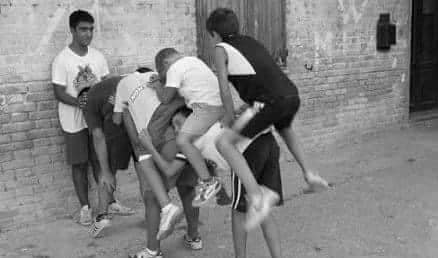
One warm July afternoon, after the sun had softened its rays, a group of children and teenagers gathered once more in the courtyard. It was time for their favorite game, which they called “Raqe raqe – hip e zdrip” (Raqe raqe – mount and step down). Grandfather stepped down from the veranda, took a small hawthorn branch, drew a circle on the ground and then told the children to cast the lots. Two teams were quickly formed, six players each. Every team wrote its secret number on the ground, covering it so the other would not see. After a few moments of laughter and whispers on the team’s strategy, Genti’s guessed the others’ number correctly and that qualified them to start the game as the riders. The opposing group formed the “human horse.”
Ardian, the tallest boy, bent forward and braced his shoulder on the shoulder of his teammate Erjon standing with this back against the stone wall of the courtyard — thereby becoming the “pillow” of the game. One after another, the rest lined up behind them, creating a long, sturdy chain. Then came the most exciting part. The riders, laughing and teasing each other, secretly chose a number that would challenge the “horse.” One by one, they leapt onto the backs of their friends, trying hard not to fall or touch the ground. The tension rose with each jump — and so did the bursts of laughter every time someone lost balance. When all the riders were up, Genti, the leader, raised his hand and shouted: “Raqe raqe ki ki ko, how many fingers do I show?” He lifted four fingers in secret. Ardian, struggling under the weight, frowned in concentration while his teammates whispered their guesses. Finally, taking a deep breath, he said the number four. The courtyard erupted in cheers and laughter. His team had guessed correctly. The sides switched places and the game began anew — bursting with good-natured teasing and joy.
Grandfather Vathi, watching the scene, could not help but laugh along. The game reminded him of his own youth, when he and his friends played the same game beneath the shade of a great walnut tree. At the end, as sweat ran down their faces and their eyes gleamed with delight, the old man told them that in the days of his youth playing had been even harder for children often played barefoot and every pebble would be felt beneath their feet.
One warm July afternoon, after the sun had softened its rays, a group of children and teenagers gathered once more in the courtyard. It was time for their favorite game, which they called “Raqe raqe – hip e zdrip” (Raqe raqe – mount and step down). Grandfather stepped down from the veranda, took a small hawthorn branch, drew a circle on the ground and then told the children to cast the lots. Two teams were quickly formed, six players each. Every team wrote its secret number on the ground, covering it so the other would not see. After a few moments of laughter and whispers on the team’s strategy, Genti’s guessed the others’ number correctly and that qualified them to start the game as the riders. The opposing group formed the “human horse.”
Ardian, the tallest boy, bent forward and braced his shoulder on the shoulder of his teammate Erjon standing with this back against the stone wall of the courtyard — thereby becoming the “pillow” of the game. One after another, the rest lined up behind them, creating a long, sturdy chain. Then came the most exciting part. The riders, laughing and teasing each other, secretly chose a number that would challenge the “horse.” One by one, they leapt onto the backs of their friends, trying hard not to fall or touch the ground. The tension rose with each jump — and so did the bursts of laughter every time someone lost balance. When all the riders were up, Genti, the leader, raised his hand and shouted: “Raqe raqe ki ki ko, how many fingers do I show?” He lifted four fingers in secret. Ardian, struggling under the weight, frowned in concentration while his teammates whispered their guesses. Finally, taking a deep breath, he said the number four. The courtyard erupted in cheers and laughter. His team had guessed correctly. The sides switched places and the game began anew — bursting with good-natured teasing and joy.
Grandfather Vathi, watching the scene, could not help but laugh along. The game reminded him of his own youth, when he and his friends played the same game beneath the shade of a great walnut tree. At the end, as sweat ran down their faces and their eyes gleamed with delight, the old man told them that in the days of his youth playing had been even harder for children often played barefoot and every pebble would be felt beneath their feet.
There is no audio content available. Add an audio URL in the admin panel.
There is no video content available. Add a video URL in the admin panel.
Historical period:
Passed down from generation to generation, clearly documented during the 19th–20th centuries.
Historical overview of the period
Albanian folk games are a vivid testimony to a rich and creative culture accompanying entire generations. In the absence of modern toys or advanced technology, Albanian children and youth invented games played in open spaces — be those courtyards of homes, green meadows or the narrow lanes of villages and small towns. These games were not merely a pass time, but a means of cultivating social bonds and cooperation, as also physical and mental agilities.
Conditions that gave rise to the event
In traditional Albanian society, children spent their time together outdoors, using imagination and creativity to invent games that required little or no equipment. These activities were both playful and formative, teaching the youngsters about social roles, teamwork and resilience.
Message
The game “Raqe raqe – hip e zdrip” stands as a clear expression of shared joy, emphasizing team spirit, cooperation and solidarity among participants. It shows how simplicity and imagination can create moments of lasting happiness and strengthen community ties. In modern times, as digital entertainment dominates children’s free hours, preserving and promoting traditional folk games gains ever more importance. They offer a joyful and educational way to reconnect younger generations with the healthy values of friendship, play and life in nature.
Meaning in Today’s Context
In modern times, when technology has taken over children’s free time, preserving and promoting such traditional games is more important than ever. They provide a wonderful way to educate the new generation in the healthy values of cooperation and outdoor play. Preserving traditional games like "Raqe raqe - hip e zdrip" is a way to bring back the joy of outdoor play and the importance of community, teaching the younger generation the values of society and physical activity.
Bibliography
- Shala, Luigj. Lojërat popullore [Popular games]. Tiranë: Akademia e Studimeve Albanologjike, 2021.