Event
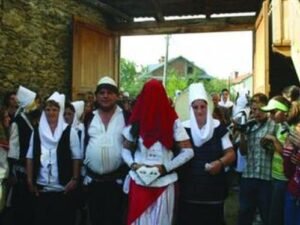
In a remote village of Malësia e Madhe, spring’s arrival was heralded by singing and the scent of freshly washed wool. On the eve of every wedding, courtyards glowed with great bonfires. The night before the ceremony took place was known as “The Night of the Xhubleta.” According to local lore, it was more than a night of joy, for it was an ancient ritual, where every gesture carried the weight of meaning.
At dusk, the elder women would bring the looms close to the fire. Strands of wool, dyed with walnut bark and madder root, shimmered under the flickering light. Young women — among them the brides-to-be — twisted black braids (gajtan) over white fabric, their hands moving in rhythm with old wedding songs. Each verse was like a prayer: a wish for protection and harmony for the new marriage. They said the songs “bind the dress to the heart.”
At midnight, the rhapsodes took their turn. They sang of the Bride of the Mountain, the legendary heroine who, according to belief, brought to these highlands the first model of the Xhubleta — the bell-shaped traditional dress. It was said that she wore it to preserve the mountain’s strength and to bless every home that remembered her name. Each time the song echoed, the braids on the garments seemed to move gently, carrying the power of that mythical figure.
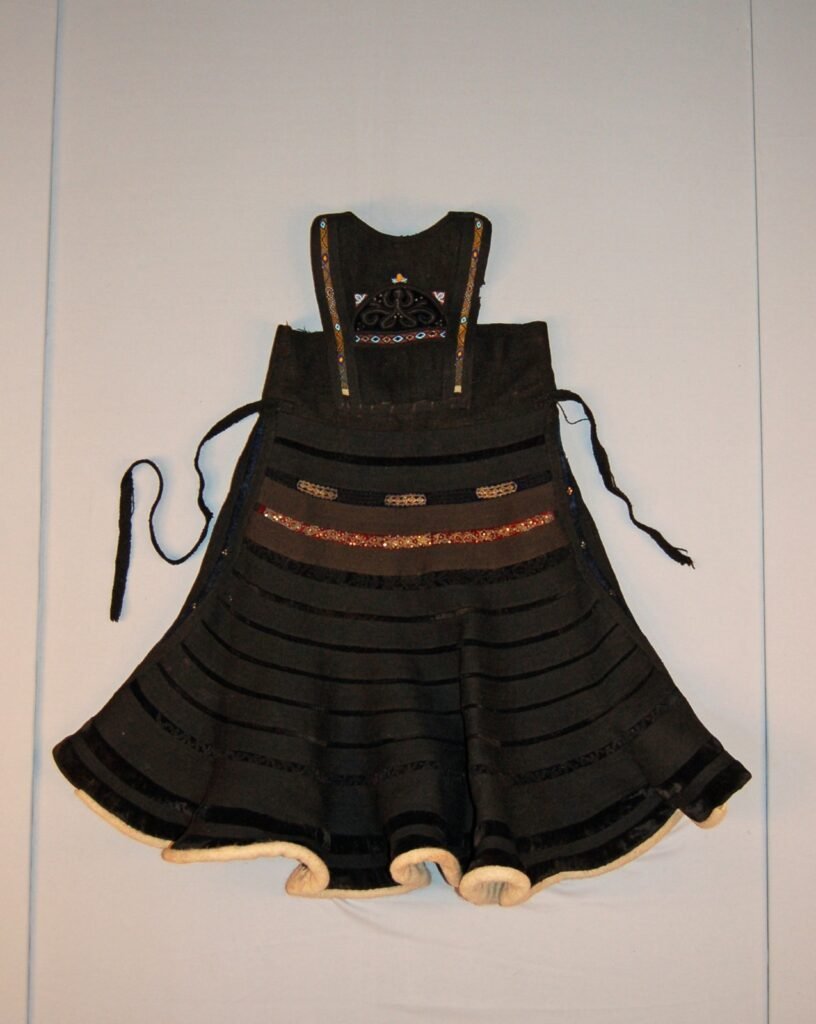
When dawn broke, the first light of day found the brides dressed in the Xhubleta they had woven with their own hands. The garment was not mere clothing attire: every line, coin and layered fold held a memory, a prayer, and a sign of identity. As UNESCO emphasized in its 2022 inscription, the Xhubleta carries symbolic codes and is accompanied by songs and stories that sustain the community’s identity. Even today, this ritual endures in many villages of Malësia. Workshops reopen, old songs are revived and the younger generations learn to “read” the signs of the xhubleta as a living language. “As long as the song of the Bride of the Mountain is sung, the Xhubleta will never die,” say the elders — turning the Night of the Xhubleta into a timeless celebration where art, love and identity meet.
At midnight, the rhapsodes took their turn. They sang of the Bride of the Mountain, the legendary heroine who, according to belief, brought to these highlands the first model of the Xhubleta — the bell-shaped traditional dress. It was said that she wore it to preserve the mountain’s strength and to bless every home that remembered her name. Each time the song echoed, the braids on the garments seemed to move gently, carrying the power of that mythical figure.
When dawn broke, the first light of day found the brides dressed in the Xhubleta they had woven with their own hands. The garment was not mere clothing attire: every line, coin and layered fold held a memory, a prayer, and a sign of identity. As UNESCO emphasized in its 2022 inscription, the Xhubleta carries symbolic codes and is accompanied by songs and stories that sustain the community’s identity. Even today, this ritual endures in many villages of Malësia. Workshops reopen, old songs are revived and the younger generations learn to “read” the signs of the xhubleta as a living language. “As long as the song of the Bride of the Mountain is sung, the Xhubleta will never die,” say the elders — turning the Night of the Xhubleta into a timeless celebration where art, love and identity meet.
There is no audio content available. Add an audio URL in the admin panel.
There is no video content available. Add a video URL in the admin panel.
Historical period:
From the Late Middle Ages to the mid-20th century, flourishing during the 18th–19th centuries in urban centers and in regions with strong textile traditions. The practice continues into the 21st century through museums, artisan workshops and the cultural scene both in Albania and abroad.
Historical overview of the period
Alongside the weaving of wool, silk and cotton textiles, the art of tailoring and decorating traditional clothing with gold and silver threads, braids and ornamental ribbons, held a central place in Albanian craftsmanship. Together with song, dance and music, dressing attire became one of the most visible expressions of folk art, setting the Albanian world apart within the broader Balkan landscape.
From medieval icons and frescoes depicting noble attires down to the Ottoman period when velvet and golden threads spread through the cities, traditional dresses evolved into a mosaic of regional styles, each element carrying profound meanings. European travelers and intellectuals were deeply impressed by these Albanian traditional attires. Lord Byron and his companion John Cam Hobhouse (Lord Broughton) wrote admiringly of Albanian costumes. Byron’s portrait dressed in Albanian attire became an icon of 19th-century Europe and of the Romantic movement itself. In the early 20th century, Faik Konica likewise chose this visual language of national representation, posing for portraits in the southern Albanian costume during official events, turning dressing into a silent yet powerful diplomacy.
The craft of dressmaking grew with the cities, the expansion of markets and the circulation of raw materials. Tailors and embroiderers’ guilds (esnafs) established strict hierarchies — apprentice, journeyman, master — and maintained high standards of skill. In the villages, loom work passed from mother to daughter, preserving home-based textile techniques. Mediterranean influences brought new motifs such as arabesques and rosettes, yet these were reinterpreted through local aesthetics — black braid on white cloth, golden thread on red velvet, bold contrasts still captivating viewers of museum collections to-the-day.
Social events such as engagements, weddings, religious and seasonal festivities elevated costumes status as both symbolic and economic capital. A fine costume was not just “new clothing” for it was the calling card of a household, the proof of work, dignity and prosperity.
The process began with the material itself: wool was spun and woven for men’s trousers (tirq), the Xhubleta or skirts, while cotton and silk were used for shirts, aprons and embroidered panels. Natural dyes made of walnut husk, madder and indigo, yilded vibrant and lasting colors. Tailors cut and shaped the garments by regional type, while embroiderers decorated their surfaces with gold and silver threads, silk cords and fine gajtan braids forming arabesques, rosettes, braids and parallel bands.
Silver buttons, coin pendants and even filigree details created texture, rhythm and light. Finally, meticulous pressing and finishing gave the garments their sculptural elegance — the result of countless unseen hours of skilled labor.
In the north, black woolen trousers (tirq) with dense braiding and the Xhubleta for women form a complete visual language. The Xhubleta, with its bell-shaped form, tiered structure, colorful belts and metallic decorations, is among the oldest garments of the Albanian cultural sphere. In 2022, it was inscribed on UNESCO’s Representative List of the Intangible Cultural Heritage of Humanity, giving thus international recognition to the fragile knowledge behind its making, as also encouraging highland communities to perservere in keeping it alive.
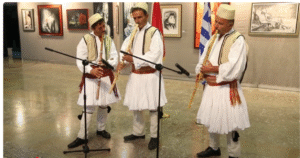
In central and southern Albania, the fustanella became the emblem of male attire, paired with an embroidered waistcoat (xhamadan), broad sash and pom-pomed shoes (opinga). Urban centers such as Shkodra, Berat, Elbasan, Korça and Gjirokastra, developed distinctive “schools” of tailoring and embroidery.
The numerous Marubi photographs and ethnographic collections provide a vivid visual map of regional styles, from the refined simplicity of the urban vest to the solemnity of the bridal ensemble. The decorative patterns were never solely aesthetic — they conveyed age, marital status, economic position and regional belonging. For a bride, the wedding costume represented the pinnacle of craftsmanship and family pride. Preserved in chests, repaired and re-sewn, it was often passed down generations as a living relic. The embellishment of clothing and weaponry with filigree was also a mark of the era. Tailors frequently collaborated with silversmiths, as belt buckles, watch chains, silver buttons and fine wire applications added a distinctive brilliance to the costume.
Conditions that gave rise to the event
Albania has an extraordinary wealth of traditional costumes — differing not only between north and south, or from one region to another, but even between neighboring villages. This story shows that from the Xhubleta, over 4,000 years old, to the fustanella of the south, from the plis to the scarves, from the traditional shoes (opingas) to the woven socks and belts — hundreds of elements, each a product of our ancestors’ tireless work, have reached us, rich with detail and beauty. Together, they form an exceptional heritage that deserves to be shown and celebrated. This recalls the story of the Xhubleta, the traditional Albanian dressmaking craft, which is now recognized as UNESCO Intangible Cultural Heritage.
Message
Today, the Albanian folk costumes continue to inspire admiration. The Ethnographic Museums of Kruja, Kavaja and Elbasan exhibit original garments, showcase techniques of their making and document regional variations — serving as open classrooms where children and adults alike can “read” the signs of the past. Across Albania, artisans still sew and embroider on commission, while the bazaar of Kruja remains renowned for workshops producing traditional garments, felt caps and slippers following ancestral techniques. With a contemporary approach, many designers, performers and cultural groups integrate traditional motifs into modern fashion and stage art. This creative revisiting of Albanian costume heritage shows that the latter is not confined to closed museum displays, but rather represents a living practice, adapting and evolving with time — a thread that continues to weave identity, artistry and memory together.
Meaning in Today’s Context
Today, the traditional costume remains present and highly valued. The Ethnographic Museums of Kruja, Kavaja, and Elbasan display original garments, explain the crafting techniques, and document regional variations. These institutions are not merely showcases — they are open classrooms where children and adults can “read” the symbols of the past. In the field, many artisans continue to sew and embroider custom-made pieces. The Bazaar of Kruja stands out for its workshops where traditional clothing, felt caps, and slippers are still produced following old motifs and techniques. With a contemporary approach, many designers and performing groups incorporate traditional elements into new creations. This stands as proof that this heritage is not a closed museum piece, but a living practice that continues to adapt with time.
Bibliography
- Gjergji, Andromaqi. Veshjet shqiptare në shekuj [Albanian costumes through the centuries]. Akademia e Shkencave e Shqipërisë, Tiranë, 2019.
- Shkodra, Zija. Qyteti shqiptar gjatë Rilindjes Kombëtare [The Albanian city during the National Renaissance]. Akademia e Shkencave e Shqipërisë, Instituti i Historisë.