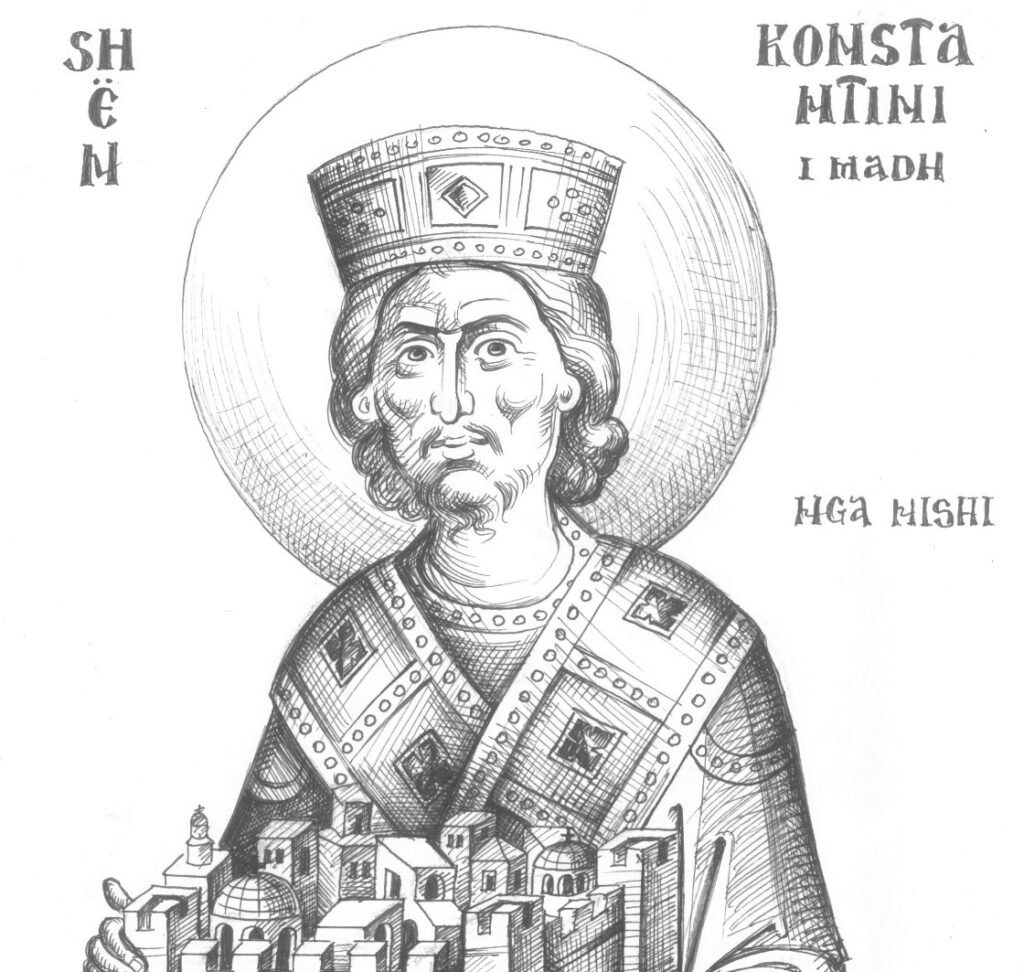
Event
In the lands of Dardania, in Niš, in 272, a boy was born who would change the fate of the world. He was the son of an Illyrian soldier, Constantius Chlorus, and a woman of deep faith – Helena. This boy, named Constantine, grew up amid the turmoil of an empire exhausted by civil wars.
He saw innocent blood flow, cities burning, emperors rising and falling like shadows. But in his heart, a desire was born: to bring order, unity, and a world where faith would not be a reason for persecution.
In the year 312, before the Battle of the Milvian Bridge against his rival Maxentius, Constantine experienced the moment that would forever mark his history. The night was difficult, the army doubted they could win. He felt the immense weight of responsibility. The confrontation between Constantine’s and Maxentius’ armies was disproportionate, as Constantine had 70,000 infantry and 8,000 cavalry, while Maxentius had 170,000 infantry and 18,000 cavalry.
As he looked at the sky, an extraordinary sign suddenly appeared: a shining cross, with the words “In hoc signo vinces” – Under this sign, you will conquer!
The next day, the army’s banners bore the sign of the cross. Constantine won the battle and became the ruler who opened a new era. In 313, he proclaimed the Edict of Milan, ending the persecutions of Christians. For the first time, the new faith could be openly declared, build churches, and celebrate its holy days. Yet he was not only an emperor of wars and laws but also of the people.
One morning in the year 321, Constantine looked out from the window of his palace in Constantinople. He was tired from the daily affairs of the empire: wars, laws, city building. His soldiers, merchants, and peasants worked tirelessly, day after day.
That day, he gathered his advisers and said:
“My people are weary. Soldiers, peasants, merchants… all work without rest. Without a day off, without time for family and for prayer, the empire will be strong only on the outside, but poor within. Let us give everyone a day for God and for the soul.”
And thus, in the year 321, he proclaimed his famous decree:
Sunday shall be a day of rest for all, a day of the Lord, a day of peace and prayer.
People began closing their shops, stopping heavy work, and gathering with their families. Churches filled with worshippers. Sunday became not only a day of rest, but also a day of light, hope, and joy.
And thus, the day that the pagans honored as the “day of the sun” (the Sun), became the day of the living Lord – Christ, the “Sun of Righteousness.” This simple decision by Constantine forever changed the rhythm of our lives. Today, more than 1,700 years later, we still preserve this gift: one day a week for peace, for love, and for remembering what holds the greatest value. And this custom has survived to our days, becoming part of the life of every generation.
He saw innocent blood flow, cities burning, emperors rising and falling like shadows. But in his heart, a desire was born: to bring order, unity, and a world where faith would not be a reason for persecution.
In the year 312, before the Battle of the Milvian Bridge against his rival Maxentius, Constantine experienced the moment that would forever mark his history. The night was difficult, the army doubted they could win. He felt the immense weight of responsibility. The confrontation between Constantine’s and Maxentius’ armies was disproportionate, as Constantine had 70,000 infantry and 8,000 cavalry, while Maxentius had 170,000 infantry and 18,000 cavalry.
As he looked at the sky, an extraordinary sign suddenly appeared: a shining cross, with the words “In hoc signo vinces” – Under this sign, you will conquer!
The next day, the army’s banners bore the sign of the cross. Constantine won the battle and became the ruler who opened a new era. In 313, he proclaimed the Edict of Milan, ending the persecutions of Christians. For the first time, the new faith could be openly declared, build churches, and celebrate its holy days. Yet he was not only an emperor of wars and laws but also of the people.
One morning in the year 321, Constantine looked out from the window of his palace in Constantinople. He was tired from the daily affairs of the empire: wars, laws, city building. His soldiers, merchants, and peasants worked tirelessly, day after day.
That day, he gathered his advisers and said:
“My people are weary. Soldiers, peasants, merchants… all work without rest. Without a day off, without time for family and for prayer, the empire will be strong only on the outside, but poor within. Let us give everyone a day for God and for the soul.”
And thus, in the year 321, he proclaimed his famous decree:
Sunday shall be a day of rest for all, a day of the Lord, a day of peace and prayer.
People began closing their shops, stopping heavy work, and gathering with their families. Churches filled with worshippers. Sunday became not only a day of rest, but also a day of light, hope, and joy.
And thus, the day that the pagans honored as the “day of the sun” (the Sun), became the day of the living Lord – Christ, the “Sun of Righteousness.” This simple decision by Constantine forever changed the rhythm of our lives. Today, more than 1,700 years later, we still preserve this gift: one day a week for peace, for love, and for remembering what holds the greatest value. And this custom has survived to our days, becoming part of the life of every generation.
There is no audio content available. Add an audio URL in the admin panel.
There is no video content available. Add a video URL in the admin panel.
Historical period:
3rd–4th century AD
Historical overview of the period
In the year 293, the Roman Empire was governed by a system called the Tetrarchy (tetra – four in ancient Greek), a power divided among four individuals created by Emperor Diocletian during a period that world historiography recognizes as the “crisis of the 3rd century.” The fourfold power (tetrarchy) as a mechanism divided decision-making authority between two senior emperors known as “Augusti” and two junior emperors known as “Caesars.” All four emperors of the tetrarchy were of Illyrian origin and belonged to the group of Roman emperors called the “Illyriciani.” Constantius I, father of Constantine the Great, was one of the four emperors of the Roman tetrarchy. After his death on July 25, 306, his son inherited the power of the empire.
After his father’s death, Constantine saw a shining cross in the sky and heard a voice saying: “Constantine, conquer under this sign and defeat your enemies.” He won all battles against his rivals, thanks to his military genius and the divine strength granted to him by God. The Battle of the Milvian Bridge in 312 is recognized as one of the most important events of antiquity and a turning point in the history of Christianity.
Once he gained absolute power, he established his residence in the city of Byzantium, renaming it Constantinople (the city of Constantine), today’s Istanbul, which would later become the new capital of the empire (the New Rome) and hold this status for over 1,000 years. The Constantinian dynasty would rule the Roman Empire until 363.
After his passing, Constantine was buried in the Church of the Holy Apostles in Constantinople. The church was dedicated to the Twelve Apostles of Jesus and was among the many churches that had begun to rise by the order of Constantine the Great. The church was unfinished when Constantine died in 337, and it was completed by his son and successor Constantius II, who buried his father’s remains there. Today, this church no longer exists; it was destroyed after the fall of Constantinople when it fell into Ottoman hands (1453), and in its place, the Fatih Mosque began to be built (1463). A fragment thought to have been the sarcophagus of Constantine the Great is preserved today in the Istanbul Archaeological Museum.
Conditions that gave rise to the event
Constantius I (Flavius Valerius Constantinus) was born on February 27, 272, in Niš of ancient Dardania, a city inhabited by Illyrian populations. He was the son of Constantius Chlorus, a high-ranking Roman officer of Illyrian origin and one of the tetrarchs of the Empire, and Helena.
After his father’s death in 306, Constantine inherited power and became involved in the civil wars that divided the empire. He eliminated his rivals one by one – first Maxentius in the decisive Battle of the Milvian Bridge in 312, and then Licinius in 324 – becoming the sole ruler of Rome. Two key acts immortalized his name:
* The Edict of Milan (313), which guaranteed religious freedom and ended the persecutions of Christians.
* The First Council of Nicaea (325), where the Christian Creed was drafted and the unity of the Church established.
Alongside this, he carried out deep administrative and military reforms, strengthened the empire’s finances by introducing the “solidus” coin, and built major churches – including the Church of the Holy Sepulchre in Jerusalem. By a special decree in 321, he proclaimed Sunday as a day of rest in the Empire. In 330, he founded a new capital at Byzantium, which he named Constantinople. This city would become the “New Rome” and the heart of the Eastern Roman Empire for more than a millennium.
His legacy is twofold: as a great reformer of the empire and as a champion of Christianity. For this, history honors him with the title Constantine the Great.
Message
Constantine the Great teaches us that true leadership is built on vision, faith, tolerance, and the courage to unite people, even when times are filled with doubt.
Meaning in Today’s Context
Constantine triumphed not only with the sword, but with faith. In the moment he felt fear and doubt, he relied on a sign and an ideal greater than himself. With the Edict of Milan, he ended the persecution of Christians. This act was one of the first steps toward the modern idea of religious freedom, where tolerance, coexistence, and respect for different beliefs form the foundation for peace and stability.
He inherited an empire divided by civil wars, yet he sought to unite it through a common ideal.
The building of Constantinople was not merely a political act, but a project meant to endure for centuries. The message for today: leaders and societies must think beyond the present, building institutions, cities, and values that serve future generations.
Bibliography
- Loka, N., GENIVS ILLYRICI – Forty-two Illyrian Emperors of Rome, Mirdita, 2005
- Adhami, S., Albanian Contributions in the Chronicle of Peoples – 2, “ADA” Publications, Tirana 2007
- Eusebius Pamphilus, THE ECCLESIASTICAL HISTORY, Translated from the Original, by Rev. C. F. Cruse, A.M., Eighth Edition, Dayton & Saxton, New York, 1842
- Llukani, A., SINAKSARI I MADH, “Trifon Xhagjika” Publications, Tirana, 2013
- Walker, W., A History of The Christian Church, Charles Scribner’s Sons, New York, 1921
- Angelo, A., GENEALOGIA D’Imperatori Romani et Constantinopolitani et de Regi Prencipi et Signori, Fratelli Breſciani, Roma, MDLI ,1551
- MENOLOGIUM GRÆCORUM, Pars Tertia, A Mense Martio Ad Augustum,1727
- Eusebius Pamphilus, THE ECCLESIASTICAL HISTORY, Translated from the Original, by REV. C. F/CRUSE, A. M., Eight Edition, Dayton & Saxton, New York, 1842
- Wilkes, J., The Illyrians, Blackwell Publishers Inc., Cambridge, Massachusetts, USA, 1996
- Philip Schaff “History of the Christian Church”, Vol. III: Nicene and Post-Nicene Christianity A.D. 311–600 , 1858–1890. Ribotime: Hendrickson Publishers, 1996.
- Eusebius of Caesarea, Life of Constantine (Vita Constantini), A.D. 337
- Modern translations: Penguin Classics, 1999.
- H.A. Drake, “ Constantine and the Bishops”- The Politics of Intolerance, Baltimore: Johns Hopkins University Press, 2000.
- R. L. Wilken, The First Thousand Years: A Global History of Christianity, Yale University Press, 2012.
- Sozomen, Ecclesiastical History , A.D 450, Post-Nicene Fathers, Second Series, Vol. II 1890.