Event
That morning, the sea was calm and the ships glided slowly toward the Adriatic shore. The sun shimmered upon the blue waters. Dyrrachium, the ancient city, gradually revealed itself on a green hillside. Travelers gathered on deck, eyes fixed on the coast, waiting eagerly to glimpse the monument that had drawn them from the farthest edges of the Empire — the newly built amphitheatre everyone was talking about.
Epikadēs, together with his father, had come expressly to witness the festive inauguration of the Amphitheatre of Dyrrachium and the opening its doors for the first time. They disembarked and wandered through the cobbled streets leading to the city’s center, amid the hum of footsteps, the scent of wine and the sharp tang of lime. Taverns buzzed with the lively voices of people drinking, talking and passionately debating. The topic at every table being one and only: the finest gladiators who that day would fight in the arena. No one could recall any such a spectacle — twelve pairs of combatants, each acclaimed as surpassing the strength and repute of the other.
— Come, said his father, guiding him toward the southern entrance of the amphitheatre. They entered the cool gallery shade where few people passed. There, upon a block of stone, was an ancient inscription. Epikadēs approached and read aloud the faded words, still resonant despite the passage of time: “Kleosthenes, son of Pontius, victor in the four-horse chariot race at the Olympic Games. Erected in honor of the city and for the glory of the gods.” Epikadēs touched the stone, feeling the weight of history it carried. It was not merely an inscription. It was a link to the past, to the people who had brought honor to Dyrrachium and given it renown across the world. It was the first time he had come face to face with such a direct trace from such glory of the distant past — a young man from his own city competing and triumphing among the world’s best. Epikadēs said nothing, but within him rose a deep reverence for someone he had never known.
He turned his eyes toward the arena. The gladiators had begun their combats. The spectators’ shouts rose and fell like waves beneath the clear sky of Dyrrachium, as history and the present clashed in a magnificent encounter. The amphitheatre was not a cold monument, but the city’s beating heart — a place where the glory of the past and the strength of the present coexisted in timeless harmony.
Epikadēs, together with his father, had come expressly to witness the festive inauguration of the Amphitheatre of Dyrrachium and the opening its doors for the first time. They disembarked and wandered through the cobbled streets leading to the city’s center, amid the hum of footsteps, the scent of wine and the sharp tang of lime. Taverns buzzed with the lively voices of people drinking, talking and passionately debating. The topic at every table being one and only: the finest gladiators who that day would fight in the arena. No one could recall any such a spectacle — twelve pairs of combatants, each acclaimed as surpassing the strength and repute of the other.
— Come, said his father, guiding him toward the southern entrance of the amphitheatre. They entered the cool gallery shade where few people passed. There, upon a block of stone, was an ancient inscription. Epikadēs approached and read aloud the faded words, still resonant despite the passage of time: “Kleosthenes, son of Pontius, victor in the four-horse chariot race at the Olympic Games. Erected in honor of the city and for the glory of the gods.” Epikadēs touched the stone, feeling the weight of history it carried. It was not merely an inscription. It was a link to the past, to the people who had brought honor to Dyrrachium and given it renown across the world. It was the first time he had come face to face with such a direct trace from such glory of the distant past — a young man from his own city competing and triumphing among the world’s best. Epikadēs said nothing, but within him rose a deep reverence for someone he had never known.
He turned his eyes toward the arena. The gladiators had begun their combats. The spectators’ shouts rose and fell like waves beneath the clear sky of Dyrrachium, as history and the present clashed in a magnificent encounter. The amphitheatre was not a cold monument, but the city’s beating heart — a place where the glory of the past and the strength of the present coexisted in timeless harmony.
There is no audio content available. Add an audio URL in the admin panel.
There is no video content available. Add a video URL in the admin panel.
Historical period:
2nd–4th centuries CE
Historical overview of the period
The city of Dyrrachium, one of the most important ports on the eastern Adriatic, gained particular significance during the Roman period. Emperor Augustus settled there a large number of veterans, granting them Roman citizenship and elevating the city to the status of a Roman colony. As Dyrrachium grew into a regional center of major importance, the need arose for the construction of an amphitheatre worthy of its stature.
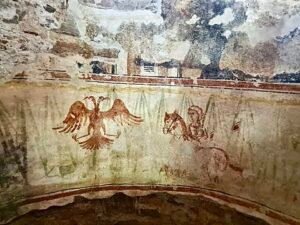
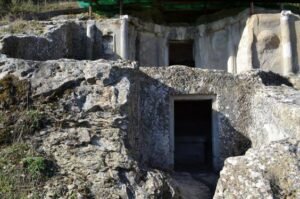
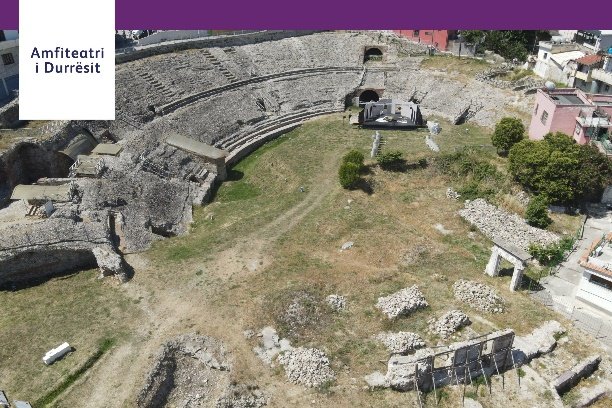
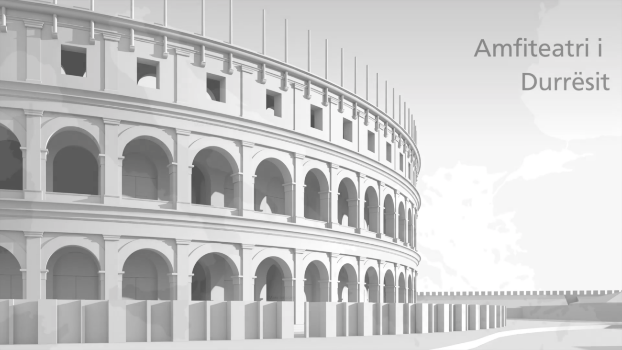
Built in the 2nd century CE, the Amphitheatre of Dyrrachium ranks among the largest in the Balkans (amphitheatres are rare along the eastern Adriatic coast), with a capacity estimated between 15,000 and 20,000 spectators. Constructed on the southwestern slope of the city hill, it commands a monumental view. Its façade, three stories high and facing the sea, gave the structure a grand architectural presence visible from afar.
Conditions that gave rise to the event
According to an inscription (CJL III, 1, 607), twelve pairs of gladiators fought during the amphitheatre’s inauguration games. Although it was not used for Olympic contests in the classical sense, the building embodied the Roman ideal of physical spectacle, valor in confrontation and public glory for the victors. Local tradition connects the amphitheatre to earlier athletic triumphs and the enduring memory of those who had returned from Olympia as champions. One of the most renowned was Kleosthenes of Dyrrachium, son of Pontius, who won the four-horse chariot race (Pausanias, VI 10.6) and dedicated his prize — depicting the chariot, the horses, their driver and owner — to his native city.
Message
This story highlights the deep bond between past and present and the power of historical memory in shaping both personal and collective identity. Through Epikadēs’ eyes, we perceive how the Amphitheatre of Dyrrachium (modern Durrës) represents not merely a physical structure but a living space where ancient glory and contemporary vitality meet in eternal harmony. At its core, this narrative speaks of the enduring strength of memory, the link to one’s roots, and how the past continues to define the present and inspire the future.
Meaning in Today’s Context
Through respect and honor for history, a sense of belonging and identity, and the symbol of continuity and the strength of tradition and culture, preserving historical memory and our connection to our roots form the foundation of our strength and identity today. In a constantly changing world, where culture and traditions risk being lost, valuing the past gives us persistence and inspiration to build a sustainable and meaningful future.
Bibliography
- Islami, Selim. Historia e Dyrrahut në Antikitet [The history of Dyrrachium in Antiquity]. Tiranë: Akademia e Shkencave, 1984.
- Toçi, Vangjel. Amfiteatri i Dyrrahut [The Amphitheatre of Dyrrachium], Monumentet 2 (1971), pp. 37–42.
- Santoro, Sara; Moderato, Michele. “Il paesaggio urbano e territoriale di Epidamnos–Dyrrachium/Dyrrachion in una visione diacronica,” in Giovanni Mastrocinque (ed.), Paesaggi mediterranei di età romana: archeologia, tutela, comunicazione, Bari, 2017, pp. 39–47.
- Beste, Heinz Jürgen; von Hesberg, Henner; Shehi, Eduard. Das Amphitheater in Dyrrachium: Rekonstruktion und Bedeutung (with contributions by Dominik Lenyel and Catherine Toulouse), Römische Mitteilungen 129 (2023), pp. 152–235.