Event
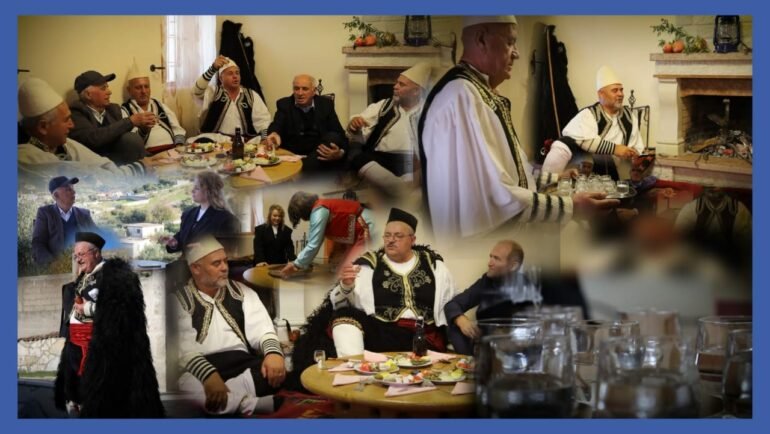
Have you heard of the Albanian toast — dollia? You should know it is not merely the lifting of a glass, but a ritual of honor whereby raki (or another traditional drink) is accompanied with words of goodwill and respect uttered as a blessing of the soul.
From the first words of welcome to the solemn wishes for the family’s fortune, dollia follows an unwritten yet perfectly understood order among those who partake. The host raises the first glass, followed by the guest, always with accompanying reverence and gracious words. There is no room for offense, but rather only for honor, remembrance and gratitude. It reflects the Albanians’ deep affection and respect toward one another. So powerful is the moment of dollia between host and guests that a foreigner might marvel at the warmth and dignity outpoured in a single night of shared toasts. A unique tradition not to be found elsewhere.
In the district of Gramsh this custom takes on a particularly national symbolism. The host always closes the toast with the words: “We raise this toast [otherwise called “health”] for the Flag. Long may it live and wave!” At that moment, all present rise and respond in unison: “Always in the hands of the Albanian!” This rare ritual, preserved only in Gramsh, is a symbolic act uniting household honor with national honor. The Flag, sanctified at the heart of the toast, becomes the highest emblem of unity, loyalty and Albanian pride.
The dollia ancient ritual survives most vividly and solemnly in the region of Skrapar, where it has its own laws passed faithfully from generation to generation.
It is said that, long ago, during a harsh winter in the mountains of Skrapar laying buried in snow, a stranger knocked on the door of a remote house. The master of the home, as custom dictated, welcomed him and set the table. When the men gathered around the raki, the host raised his glass: “For the guest we do not yet know — but whose heart, through words, shall soon be revealed”…
“I have found you o friend!”
“May goodness find you!” replied the guest and glasses were then raised one toast after the other.
That night, in the rounds of toasts for parents, grandparents and departed ones, an old memory rekindled like a flame beneath the ashes: their grandfathers had once served together as soldiers (nizamë) in far away in Anatolia. Amidst exhaustion in battles, they had shared bread and water, as so wounds, sealing between them a brotherhood of blood.
The younger men had not known this link, but the dollia’s warm words and the raki that stirs reminiscences had brought it back to life. That night forged a friendship that would endure forever: this was no unknown guest, but an old friend whom the road had merely delayed on its way to reaching the host.
Since that evening, every year on the same date, the two families raise a toast in memory of that first dollia that bound them through shared roots and inherited honor.
This story, found in many variations across Albania, carries an enduring truth: the Albanian toast is not merely a good wish. It is a bridge between hearts, a memory revived through the cup, a promise flowing from generation to generation. In the rhythm and musicality of dollia’s speech there resides the honor of a people lifting the cup wholeheartedly and giving blessing from within the soul.
From the first words of welcome to the solemn wishes for the family’s fortune, dollia follows an unwritten yet perfectly understood order among those who partake. The host raises the first glass, followed by the guest, always with accompanying reverence and gracious words. There is no room for offense, but rather only for honor, remembrance and gratitude. It reflects the Albanians’ deep affection and respect toward one another. So powerful is the moment of dollia between host and guests that a foreigner might marvel at the warmth and dignity outpoured in a single night of shared toasts. A unique tradition not to be found elsewhere.
In the district of Gramsh this custom takes on a particularly national symbolism. The host always closes the toast with the words: “We raise this toast [otherwise called “health”] for the Flag. Long may it live and wave!” At that moment, all present rise and respond in unison: “Always in the hands of the Albanian!” This rare ritual, preserved only in Gramsh, is a symbolic act uniting household honor with national honor. The Flag, sanctified at the heart of the toast, becomes the highest emblem of unity, loyalty and Albanian pride.
The dollia ancient ritual survives most vividly and solemnly in the region of Skrapar, where it has its own laws passed faithfully from generation to generation.
It is said that, long ago, during a harsh winter in the mountains of Skrapar laying buried in snow, a stranger knocked on the door of a remote house. The master of the home, as custom dictated, welcomed him and set the table. When the men gathered around the raki, the host raised his glass: “For the guest we do not yet know — but whose heart, through words, shall soon be revealed”…
“I have found you o friend!”
“May goodness find you!” replied the guest and glasses were then raised one toast after the other.
That night, in the rounds of toasts for parents, grandparents and departed ones, an old memory rekindled like a flame beneath the ashes: their grandfathers had once served together as soldiers (nizamë) in far away in Anatolia. Amidst exhaustion in battles, they had shared bread and water, as so wounds, sealing between them a brotherhood of blood.
The younger men had not known this link, but the dollia’s warm words and the raki that stirs reminiscences had brought it back to life. That night forged a friendship that would endure forever: this was no unknown guest, but an old friend whom the road had merely delayed on its way to reaching the host.
Since that evening, every year on the same date, the two families raise a toast in memory of that first dollia that bound them through shared roots and inherited honor.
This story, found in many variations across Albania, carries an enduring truth: the Albanian toast is not merely a good wish. It is a bridge between hearts, a memory revived through the cup, a promise flowing from generation to generation. In the rhythm and musicality of dollia’s speech there resides the honor of a people lifting the cup wholeheartedly and giving blessing from within the soul.
There is no audio content available. Add an audio URL in the admin panel.
There is no video content available. Add a video URL in the admin panel.
Historical period:
As old as life itself — still vibrantly practiced today.
Historical overview of the period
The tradition of the dollia across Albanian lands is rooted in an ancient worldview where speech and drink — especially raki — were sacred elements of hospitality. In patriarchal Albanian society, the table was governed by unwritten laws of honor, faith and respect for the guest. Within this setting, the toast was not just a prelude or conclusion to a shared meal, but rather a solemn moment of recognition and honoring of friendship, family, warriors, departed ones and life itself. By the 18th–19th centuries, especially in southern Albania, dollia had become a structured social code, transmitted through generations. After the 20th century, sociopolitical changes and Albania’s engagement in international cultural organizations brought dollia under the researchers’ focus and eventually its recognition as an element of intangible spiritual heritage.
Conditions that gave rise to the event
Albanians have long been known for their deep sense of hospitality and their reverence for the spoken word. In societies where moral law outweighed written law, one’s word carried immense weight. In this moral landscape, the appearance of dollia as a solemn, act intertwining drinking –blessing and good wishing – fulfilled the need to maintain social harmony and ethical order. It emerged from collective relationships of traditional life, where every public act, even the lifting of a cup, bore not of social or festive value but was in fact imbued with profound ethical meaning.
Message
The dollia is an expression of Albanian ethics of hospitality. It shows how Albanians have honored the spoken word, friendship and life through organized and solemn gestures. When the Albanian raises the glass, it is not a simple act of drinking, for it is also an act of prayer, honoring and remembrance. To-the-day dollia remains a living part of social life — at weddings, gatherings and everyday meetings. Though modern life brings new forms of communication, its tone and essence remain unchanged. Among particular Albanian communities abroad, dollia represents a living bond with cultural roots and efforts are underway to protect it as part of Albania’s intangible spiritual heritage. In a world that grows ever faster and more fragmented, the Albanian toast continues to be a receptacle of warmth, solidarity, honor and blessings for life.
Meaning in Today’s Context
In today's world, the toast remains a living part of Albanian social life, whether at weddings, gatherings, or friendly meetings. Although the modern context has brought new forms of communication and socialization, the rhythm and spirit of the toast remain essentially unchanged. In some Albanian communities abroad, it represents a way of staying connected to cultural roots. Today, there are efforts to preserve the toast as part of the spiritual heritage of the Albanian people. In a world that is developing ever faster, yet becoming more fragmented, the toast conveys warm values of solidarity, honor, and the celebration of life.
Bibliography
- Bundo, Sherif. Dollia shqiptare si akt shpirtëror dhe etik [Dollia - The Albanian toast as a spiritual and ethical act]. Tiranë: Akademia e Studimeve Albanologjike, 2021.
- Elsie, Robert. Albanian Folklore and Oral Tradition. Wiesbaden: Otto Harrassowitz, 2004.
- Mandala, Peter. The Anthropology of Ritual Speech in the Balkans. Thessaloniki: Balkan Cultural Review, 2010.